Senin, 19 September 2011

Being glucose intolerant may make you live only to be 96, if you would otherwise live to be 100

This comes also from the widely cited Brunner and colleagues study, published in Diabetes Care in 2006. They defined a person as glucose intolerant if he or she had a blood glucose level of 5.3-11 mmol/l after a 2-h post–50-g oral glucose tolerance test. For those using the other measurement system, like us here in the USA, that is a blood glucose level of approximately 95-198 mg/dl.

Quite a range, eh!? This covers the high end of normoglycemia, as well as pre- to full-blown type 2 diabetes.

In this investigation, called the Whitehall Study, 18,403 nonindustrial London-based male civil servants aged 40 to 64 years were examined between September 1967 and January 1970. These folks were then followed for over 30 years, based on the National Health Service Central Registry; essentially to find out whether they had died, and of what. During this period, there were 11,426 deaths from all causes; with 5,497 due to cardiovascular disease (48.1%) and 3,240 due to cancer (28.4%).

The graph below shows the age-adjusted survival rates against time after diagnosis. Presumably the N values refer to the individuals in the glucose intolerant (GI) and type 2 diabetic (T2DM) groups that were alive at the end of the monitoring period. This does not apply to the normoglycemic N value; this value seems to refer to the number of normoglycemic folks alive after the divergence point (5-10 years from diagnosis).


Note by the authors: “Survival by baseline glucose tolerance status diverged after 5-10 years of follow-up. Median survival differed by 4 years between the normoglycemic and glucose intolerant groups and was 10 years less in the diabetic compared with the glucose intolerant group.”

That is, it took between 5 and 10 years of high blood glucose levels for any effect on mortality to be noticed. One would expect at least some of the diagnosed folks to have done something about their blood glucose levels; a confounder that was not properly controlled for in this study, as far as I can tell. The glucose intolerant folks ended up living 4 years less than the normoglycemics, and 10 years more than the diabetics.

One implication of this article is that perhaps you should not worry too much if you experience a temporary increase in blood glucose levels due to compensatory adaptation to healthy changes in diet and lifestyle, such as elevated growth hormone levels. It seems unlikely that such temporary increase in blood glucose levels, even if lasting as much as 1 year, will lead to permanent damage to cells involved in glucose metabolism like the beta cells in the pancreas.

Another implication is that being diagnosed as pre-diabetic or diabetic is not a death sentence, as some people seem to take such diagnoses at first. Many of the folks in this study who decided to do something about their health following an adverse diagnosis probably followed the traditional advice for the treatment of pre-diabetes and diabetes, which likely made their health worse. (See Jeff O’Connell’s book Sugar Nation for a detailed discussion of what that advice entails.) And still, not everyone progressed from pre-diabetes to full-blow diabetes. Probably fewer refined foods available helped, but this does not fully explain the lack of progression to full-blow diabetes.

It is important to note that this study was conducted in the late 1960s. Biosynthetic insulin was developed in the 1970s using recombinant DNA techniques, and was thus largely unavailable to the participants of this study. Other treatment options were also largely unavailable. Arguably the most influential book on low carbohydrate dieting, by Dr. Atkins, was published in the early 1970s. The targeted use of low carbohydrate dieting for blood glucose control in diabetics was not widely promoted until the 1980s, and even today it is not adopted by mainstream diabetes doctors. To this I should add that, at least anecdotally and from living in an area where diabetes is an epidemic (South Texas), those people who carefully control their blood sugars after type 2 diabetes diagnoses, in many cases with the help of drugs, seem to see marked and sustained health improvements.

Finally, an interesting implication of this study is that glucose intolerance, as defined in the article, would probably not do much to change an outside observer’s perception of a long-living population. That is, if you take a population whose individuals are predisposed to live long lives, with many naturally becoming centenarians, they will likely still be living long lives even if glucose intolerance is rampant. Without carefully conducted glucose tolerance tests, an outside observer may conclude that a damaging diet is actually healthy by still finding many long-living individuals in a population consuming that diet.

Senin, 12 September 2011

Fasting blood glucose of 83 mg/dl and heart disease: Fact and fiction

If you are interested in the connection between blood glucose control and heart disease, you have probably done your homework. This is a scary connection, and sometimes the information on the Internetz make people even more scared. You have probably seen something to this effect mentioned:
Heart disease risk increases in a linear fashion as fasting blood glucose rises beyond 83 mg/dl.
In fact, I have seen this many times, including on some very respectable blogs. I suspect it started with one blogger, and then got repeated over and over again by others; sometimes things become “true” through repetition. Frequently the reference cited is a study by Brunner and colleagues, published in Diabetes Care in 2006. I doubt very much the bloggers in question actually read this article. Sometimes a study by Coutinho and colleagues is also cited, but this latter study is actually a meta-analysis.

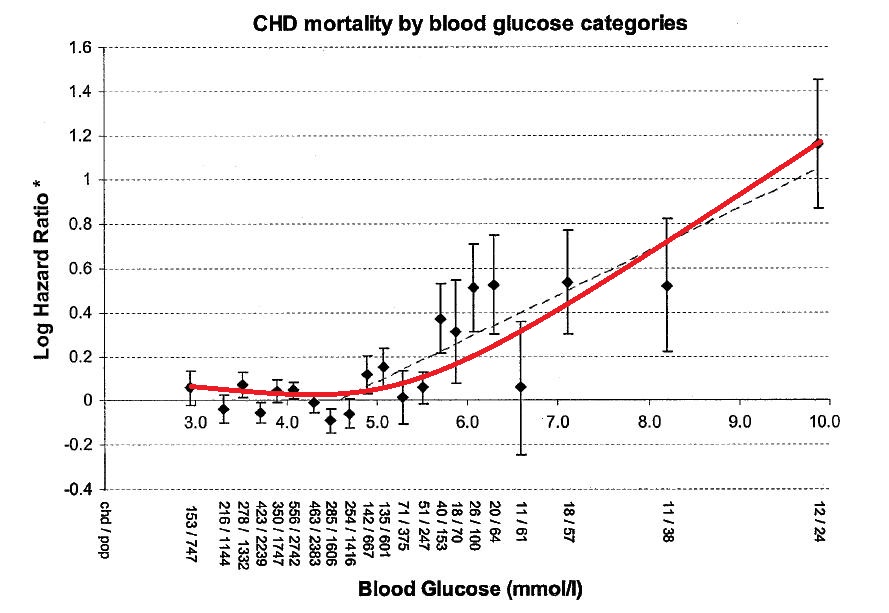
So I decided to take a look at the Brunner and colleagues study. It covers, among other things, the relationship between cardiovascular disease (they use the acronym CHD for this), and 2-hour blood glucose levels after a 50-g oral glucose tolerance test (OGTT). They tested thousands of men at one point in time, and then followed them for over 30 years, which is really impressive. The graph below shows the relationship between CHD and blood glucose in mmol/l. Here is a calculator to convert the values to mg/dl.


The authors note in the limitations section that: “Fasting glucose was not measured.” So these results have nothing to do with fasting glucose, as we are led to believe when we see this study cited on the web. Also, on the abstract, the authors say that there is “no evidence of nonlinearity”, but in the results section they say that the data provides “evidence of a nonlinear relationship”. The relationship sure looks nonlinear to me. I tried to approximate it manually below.


Note that CHD mortality really goes up more clearly after a glucose level of 5.5 mmol/l (100 mg/dl). But it also varies significantly more widely after that level; the magnitudes of the error bars reflect that. Also, you can see that at around 6.7 mmol/l (121 mg/dl), CHD mortality is on average about the same as at 5.5 mmol/l (100 mg/dl) and 3.5 mmol/l (63 mg/dl). This last level suggests an abnormally high insulin response, bringing blood glucose levels down too much at the 2-hour mark – i.e., reactive hypoglycemia, which the study completely ignores.

These findings are consistent with the somewhat chaotic nature of blood glucose variations in normoglycemic individuals, and also with evidence suggesting that average blood glucose levels go up with age in a J-curve fashion even in long-lived individuals.

We also know that traits vary along a bell curve for any population of individuals. Research results are often reported as averages, but the average individual does not exist. The average individual is an abstraction, and you are not it. Glucose metabolism is a complex trait, which is influenced by many factors. This is why there is so much variation in mortality for different glucose levels, as indicated by the magnitudes of the error bars.

In any event, these findings are clearly inconsistent with the statement that "heart disease risk increases in a linear fashion as fasting blood glucose rises beyond 83 mg/dl". The authors even state early in the article that another study based on the same dataset, to which theirs was a follow-up, suggested that:
…. [CHD was associated with levels above] a postload glucose of 5.3 mmol/l [95 mg/dl], but below this level the degree of glycemia was not associated with coronary risk.
Now, exaggerating the facts, to the point of creating fictitious results, may have a positive effect. It may scare people enough that they will actually check their blood glucose levels. Perhaps people will remove certain foods like doughnuts and jelly beans from their diets, or at least reduce their consumption dramatically. However, many people may find themselves with higher fasting blood glucose levels, even after removing those foods from their diets, as their bodies try to adapt to lower circulating insulin levels. Some may see higher levels for doing other things that are likely to improve their health in the long term. Others may see higher levels as they get older.

Many of the complications from diabetes, including heart disease, stem from poor glucose control. But it seems increasingly clear that blood glucose control does not have to be perfect to keep those complications at bay. For most people, blood glucose levels can be maintained within a certain range with the proper diet and lifestyle. You may be looking at a long life if you catch the problem early, even if your blood glucose is not always at 83 mg/dl (4.6 mmol/l). More on this on my next post.

Senin, 05 September 2011

Nonlinearity and the industrial seed oils paradox

Most relationships among variables in nature are nonlinear, frequently taking the form of a J curve. The figure below illustrates this type of curve. In this illustration, the horizontal axis measures the amount of time an individual spends consuming a given dose (high) of a substance daily. The vertical axis measures a certain disease marker – e.g., a marker of systemic inflammation, such as levels of circulating tumor necrosis factor (TNF). This is just one of many measurement schemes that may lead to a J curve.


J-curve relationships and variants such as U-curve and inverted J-curve relationships are ubiquitous, and may occur due to many reasons. For example, a J curve like the one above may be due to the substance being consumed having at least one health-promoting attribute, and at least one health-impairing attribute. The latter has a delayed effect, and ends up overcoming the benefits of the former over time. In this sense, there is no “sweet spot”. People are better off not consuming the substance at all. They should look for other sources of the health-promoting factors.

So what does this have to do with industrial seed oils, like safflower and corn oil?

If you take a look at the research literature on the effects of industrial seed oils, you’ll find something interesting and rather paradoxical. Several studies show benefits, whereas several others hint at serious problems. The problems seem to be generally related to long-term consumption, and to be associated with a significant increase in the ratio of dietary omega-6 to omega-3 fats; this increase appears to lead to systemic inflammation. The benefits seem to be generally related to short-term consumption.

But what leads to the left side of the J curve, the health-promoting effects of industrial seed oils, usually seen in short-term studies?

It is very likely vitamin E, which is considered, apparently correctly, to be one of the most powerful antioxidants in nature. Oxidative stress is strongly associated with systemic inflammation. Seed oils are by far the richest sources of vitamin E around, in the form of both γ-Tocopherol and α-Tocopherol. Other good sources, with much less gram-adjusted omega-6 content, are what we generally refer to as “nuts”. And, there are many, many substances other than vitamin E that have powerful antioxidant properties.

Chris Masterjohn has talked about seed oils and vitamin E before, making a similar point (see here, and here). I acknowledged this contribution by Chris before; for example, in my June 2011 interview with Jimmy Moore. In fact, Chris has gone further and also argued that the vitamin E requirement goes up as body fat omega-6 content increases over time (see comments under this post, in addition to the links provided above).

If this is correct, I would speculate that it may create a vicious feedback-loop cycle, as the increased vitamin E requirement may lead to increased hunger for foods rich in vitamin E. For someone already consuming a diet rich in seed oils, this may drive a subconscious compulsion to add more seed oils to dishes. Not good!

Minggu, 04 September 2011

IAAF World Champs: 800m women, questions but few answers

Women's 800m: Savinova pips Semenya

The women's 800m event deserves a post all of its own.  I'll post on the rest of the day's action a little later, but the women's 800m gold has just been won, and it wasn't Caster Semenya winning it.  Instead, it was Mariya Savinova of Russia who won in a very quick 1:55.87, edging Semenya in the final 50m.  Semenya ran 1:56.35, easily the fastest time she has done since her Berlin triumph two years ago, when the controversy began, and Janeth Jepkosgei took bronze, reward for her efforts in setting the race up with a very fast first lap.

The race was an intriguing tactical one - Janeth Jepkosgei took the pace out hard (26.61s first 200m), and led through the bell in 55.86s, with Semenya in fifth and Savinova sixth, about 5m behind.  Savinova had clearly decided that she would mark Semenya the whole way, and as Semenya made her move down the backstraight, she followed.  600m was reached in 1:26.07, a 30-second interval for Jepkosgei, probably half a second quicker for Semenya, who was on the shoulder of the leaders and poised to move clear.

Coming off the final bend, Semenya had taken the lead, and it looked like a dead certainty that she would run away from the field.  Given the fast pace up to 600m, a repeat or even an improvement of the 1:55.45 of Berlin looked on the cards.  But Savinova held her, and with 50m to go, began to close the 3m gap that she'd held her at down the back straight.  In the final, 20m, Semenya faded and Savinova come through to win gold.

Caster Semenya - the questions will continue

Semenya again looked very relaxed, casual even, when being passed for gold in the final 20m, and I am sure that there will once again be suspicions that she "lost deliberately".  In the aftermath of her semi-final, where she looked completely dominant, that theme began to reappear, with chat forums resonating with the theory that Semenya had been losing races on purpose this season to keep the attention off her.

I am sure that the questions will continue, and Semenya will again be labeled as either a cheat (if she wins), or a 'fixer' (when she loses, as people suggest, on purpose).  I think both are slightly unfair accusations, and require some clarification and context.  Certainly, she is not a cheat - she may well have had an advantage as a result of whatever intersex condition may have led to increased testosterone levels, but that's not the same as cheating.  So again, I'd caution against "personalizing" the debate, making it about Semenya.  It's not too different from Pistorius case, actually - it's not a question of cheating, but is a question of unfair advantage.  And that's certainly a valid concern, which is why the post-Berlin process happened.

In Semenya's case, and I've written this before, I am fairly certain that in the aftermath of Berlin, she did receive some medical treatment.  There is no other explanation for the length of time that it took to clear her to run.  A legal issue would have taken weeks, maybe a few months, but to miss nearly a year can only be explained if there was medical intervention that required observation.  Also, if you look at the IAAF's latest position stand on intersex conditions, they have clearly learned from the Semenya experience, and it's no co-incidence that the statement includes mention of correcting testosterone to normal female levels.  The IAAF, I think, knew that they had to intervene, and I believe they did, setting a precedent that they then wrote into future policy.

So I'm confident in saying that there was chemical treatment to reduce the testosterone levels.  That would also explain the injury problems, the inconsistencies, and the relatively poorer performances in the last twelve months.  If that is the case, then people can of course still object to Semenya's participation on the grounds that she has "historical" advantage because of the shape of the skeleton etc.  But I believe that most advantages would diminish soon, and certainly will over more time.

My opinion is that if her testosterone levels have been within the normal range for six months, and continue to stay there, then I'd be satisfied that the advantage is no longer of concern for competition.  She would be at the extreme in certain respects, but not threatening to cross the 'line' we draw to make the distinction between male and female competition.  Of course, when she runs 1:56.35, less than a second slower than the Berlin time, people will question the effectiveness of the treatment, and that will be an interesting debate to follow in coming weeks.

Monitoring of an intervention?

The big question, however, is monitoring of those levels.  The irony is that if Semenya has received chemical treatment, then she may be one of the only athletes in the world who is required to use drugs.  And failure to use the drugs (dope) would be the problem.  If Semenya's participation is dependent on lowering the testosterone levels, then ensuring the effectiveness is crucial.

Now I don't know how this has been monitored.  Is it possible that Semenya can stop medication and return to the Berlin situation?  I don't know enough about the process, how long the treatment would last or how effective it might be (will make some enquiries with endocrinologists) and so I'll steer clear of speculating on that detail. But I believe that if the testosterone levels were raised (which is a near certainty), then the right thing was done in reducing them, and I have no objections to Semenya's participation, providing it is monitored regularly.

Semenya's racing strategy

As for the theory that Semenya is running slowly on purpose, I can appreciate why people think that, because certainly, I can't think of many athletes who look as casual as Semenya in any race situation - it is so startling how she seems to "jog" when others are failing.  But I see it differently.  There are far better ways to win a silver medal, lose a race and divert attention of yourself than what Semenya did today.  If she was deliberately trying NOT to win, then it would be far easier to come through late, especially in a race like today's where early pace is fast and the gaps are large.   Would a late charge from sixth to second (possible if you watch the race) not divert attention more than a fade into silver?  But instead, Semenya attacked the race with 250m to go, assumed the lead, ran in front for the world to see, and looked to be going away before losing gold.

That's a sure way to attract attention, not to deflect it, (for proof of this, see the forums which are already buzzing with allegations of "tanking on purpose").  I remain unconvinced about this deliberate loss argument.  I think it more likely that Semenya is just a runner who always looks casual, regardless of race situation or effort.  Back in 2008, at the World Junior Championships in Poland, Semenya finished seventh in her heat and looked the same as she did today - she seems not to have it in her style to lose form and look like she is straining.  It may be the shape of her skeleton, the large upper body and that she seems to 'lope', and I think this is more likely than the theory that she hit the front, opened up a lead in the final 50m of the World Champs, and then decided to lose the race on purpose from there.

The lack of transparency

In all this, the biggest issue has been the lack of transparency and the secrecy.  The initial leak was of course wrong, and Semenya should never have been subjected to public speculation about her biological sex.  But once out, once the world knew there was a problem, it was critical to resolve the situation, or at least reassure people that something had been done to ensure fair competition (even if that meant announcing that there was no advantage to begin with - people wouldn't have believed it, but it would be something).

That was, of course, Semenya's prerogative.  The IAAF could not announce that there was a condition and that it had been treated, because the medical information belongs to the patient.  So I felt from the outset that Semenya needed to disclose something.  Not the full details, not a complete description, but something to assure people that her participation had been cleared and perhaps that she would continue to co-operate with the authorities in the future.  Maybe even release testosterone level results today, in the same way that some cyclists have taken to making public their blood data as part of the biological passport system.

The problem we have now is that everyone knows half the story, and in the absence of facts, they will create the other half!  And, whether the result of being misinformed, ignorant or hostile, the blanks that are filled in will almost always be worse than the reality.  The end result is that Semenya loses either way, and the only way I can see this being overcome is to control the information herself.

But instead of truth, what we have is a shroud of secrecy, mostly from Semenya's management.  Her management team have made some extra-ordinary statements, including one that she was going to win the double in Daegu, even though she was not even entered into the 1500m.  They have asked for millions for sponsorship back here in South Africa.  They also hinted recently that she would be asking for money to give interviews to the media, which is astonishing.

You can't blame Semenya for her mistrust of the media, but the moronic press releases made by her PR and management teams defy belief, and only serve to heighten the focus (and negative attention) on her.  She'll find a great deal of sympathy (as she should) for her character in continuing the sport, for her resolve, which has been incredible.  But she'll also face a great deal of hostility because of how little people know about the science and the process involved.

And she can control the flow of that information, including the public perception, by talking about it.  Again, cycling has set the precedent that cyclists sometimes disclose their blood data, and Semenya could do the same.  She'll never win everyone over, but I think many will accept what has happened as the best possible resolution, provided they know it.  As it stands now, few people will because they simply don't know.

On that note, it was very good to see the smiles and interaction with her fellow competitors after this race.  It's easy to be a good sport when you're winning, but even Savinova seemed more amiable than her previous comments might have suggested.  These are good signs, not proof, but hopefully a sign that among fellow athletes, things are returning to normal.

An insoluble problem?

Ultimately, Semenya's situation asks questions for which there may be no answer.  I compared it earlier to the Pistorius case, but in truth, it's even more complex, because a) there is less scientific evidence available to quantify the Semenya advantage than for Pistorius' advantage and b) there seems to have been some treatment to correct the possible advantage.  If that has happened, and the process has been followed, then what next?  Either it didn't work, or it should be accepted.  Key there is simply disclosing it, and if that were to happen, I'd encourage people to accept the treatment and the IAAF decision.   As it stands, we don't know, so how can anyone be asked be blindly accept it?

If there was no treatment, or if the treatment has not been monitored properly, well, that's a different situation, and goes all the way back to 2009 and the debates we had about eligibility at the time.  And so I'd also love for there to be some kind of disclosure so that people at least know that this has happened (if it has, of course).  And finally, I'd hope that Semenya opens up, maybe that someone saves her from her own management team, and maybe even uses this as an opportunity to inform and educate.  Full transparency, testosterone levels, the truth.

Ross

Kamis, 01 September 2011

IAAF World Champs: USA's hat-trick on a day of surprises

IAAF World Champs report Day 6:  The USA claim three on a day of surprises

Six finals, and four nations won medals today, as the USA delivered a hat-trick of titles in what was a day of mild (and big) surprises.

The USA's medals came in the form of Jesse Williams in the high jump (least surprising - he was the world leader after all), Lashinda Demus in the 400m hurdles (mildly surprising, though she was second in Berlin and is a class act, always competitive), and then Jennifer Barringer-Simpson, in the biggest surprise of all, in the women's 1500m in a very peculiar race.

Also claiming gold were Ezekiel Kemboi of Kenya (Steeplechase), Dai Greene of Great Britain (400m hurdles) and Olha Saladuha of Ukraine in the triple-jump.

A short summary of the track finals is below, along with YouTube clips of some, for those who missed them!

Kemboi explodes, celebrates and entertains for Kenya's fourth gold

Ezekiel Kemboi of Kenya defended his 3000m steeplechase world title with an incredible explosion of speed in the final 200m, opening up such a huge lead that he actually won the race in lane 7 by the end.  The sprint was on after a slow race, yet Kemboi got so far clear that he had time to celebrate pretty much from the final barrier, and drifted out into lane 7 doing so!  Brimin Kipruto got silver, holding off a fasting finishing Mahiedine Mekhissi-Benabbad on the line.

This was always going to be a fascinating race.  Earlier in the year, France's Benabbad had delivered a huge warning to Kenya that their dominance in the Steeplechase would be challenged in a big way in Daegu, when he ran away from a strong field, including Kemboi, to win the Paris Diamond League event.  On that occasion, Benabbad ran 8:02, and won by five seconds from Kemboi, and it was a performance that gave the Daegu final an added dimension - not only would it see great competition, but it might bring out a great tactical battle.

Kenya, of course, had four athletes in the race, by virtue of the fact that Kemboi was defending champion.  The other was Brimin Kipruto, who had missed the world record by 1/100th of a second earlier this season, having been led by Paul Koech in a great Diamond League race in Monaco.  Koech had been left out of this race, and so it was expected to be a Kipruto-Kemboi battle against Benabbad.  And given Benabbad's great finish in that Paris race (he put five seconds on the field in the final lap), I fully expected Kenya to send one of their two "lesser" runners out and make this a super fast race, given that Kipruto and Kemboi had run 7:55 or faster earlier this year.

That didn't happen. Then again, Bennabad didn't seem to be quite as strong as he had been in Paris, because he ran the whole race about 5m off the Kenyans, never in among them, which was surprising.  The early pace was set by Ramolefi, but it was slow - 2:47 to the first kilometer.  That was followed by 2:46, by which time the east Africans (three Kenyans and two Ugandans) were in front, and Benabbad and Tahri, also of France, just behind.  Down the back-straight, it was Kemboi and Kipruto who went clear, and only a massive late charge by Bennabad got him bronze, and in truth, he nearly caught Kipruto from behind (when you watch the video below, look at how far behind Benabbad is coming into the final straight, and watch how close he comes to catching Kipruto - he makes up about 2 seconds in 80m!  That kind of speed was however "wasted", and Benabbad, in my opinion, ran a strange race to allow that gap to appear in the first place.  I was surprised that he wasn't more attentive throughout the race, given his Paris victory and his obvious speed)

But Kemboi was untouchable today.  He was beaten into second by Kipruto in that Monaco race, running 7:55.76, but this was a championship race, and he has been remarkable in medal races in the last eight years.  Here is the list of performances:  2nd in 2003 World Champs, 1st 2004 Olympics, 2nd 2005 World Champs, 1st 2006 Commonwealth Games, 2nd 2007 World Champs, 1st 2009 World Champs and 2nd 2010 Commonwealth Games.  The only blemish was a 7th in Beijing, but other than that, Kemboi has been a 'guaranteed' silver or gold!

The video below shows the final 500m and watch for the Kemboi kick as they clear the third-last barrier at the end of the back straight.  It's so good, as mentioned, that he had time to start celebrating after the final jump, 50m from the line.  He danced over the line, and continued to celebrate, stripping off the vest and dancing, perhaps the Kenyan equivalent of Usain Bolt's "chicken dance" from Beijing!  Kemboi is a great entertainer, the sport needs it.  In all, it was a magnificent performance - that final 200m was as impressive a sprint as anything I've seen.

In case you missed it, here is a clip (not English, but the quality is the best I could find on YouTube now).  It really is worth a watch.


Jennifer Barringer-Simpson wins the 1500m title

The biggest surprise came from Jenny Barringer Simpson, who won gold in the women's 1500m in what was a strange race for a number of reasons.  For one, none of the favourites came through.  A fall with 550m unfortunately took out one of those favourites, Morgan Uceny of the USA.  Even more strange was that the big favourite, Maryan Jamal of Bahrain, began drifting away from the front of the race as early as 450m to go, was completely out of contention with 250m to go, and trailed in last place, fully 17 seconds behind the winner.  And yes, she shut down once out of contention, but her "challenge" was notable because, well, it was completely non-existent in the final 300m (she was seemingly bumped with about 450m to go, and perhaps that affected her finish.  She certainly has developed a habit of producing massively inconsistent performances though)

The USA would have had high hopes for this race, but most of them were with Uceny, who had been winning Diamond League races this season.  Barringer-Simpson was, not to be unkind, "the other American", though her 1500m credentials are impressive, including a sub-4 PB back in 2009.  It's jsut that she hadn't really showed that kind of form this year.  And so when Uceny went down in a pretty spectacular tumble with 550m to go, it seemed that the USA's chances took a drastic turn for the worse.

Not according to Barringer-Simpson - she ran a perfect race, always in contention, avoiding the barging and congestion that comes with a slow pace.  She moved out into lane two with about 150m to run, and as the final straight unfolded, she was right there, with clear track in front of her, and she took advantage.  Hannah England was a strong (and delightedly surprised) second, and Natalia Rodriguez of Spain (another pre-race favourite) faded somewhat having led into the final straight to come third.

In the end, the pace was slow, which made it all the more peculiar.  The first lap was 68.78, followed by a 65.16, leading to the congestion that would ultimately end Uceny's challenge in the fall.  The pace was ramped up with 500m to go, when Rodriguez went to the front.  She led through the bell, and all the way to about 40m to go, when Barringer-Simpson swept by. 

The final 300m were covered in about 46s, which is fast, but not spectacular - final laps of under 60 seconds have been run before (sub 45s for final 300m), off more or less the same pace.  But in the end, it was a race of attrition, a wide open race to begin with, that opened up repeatedly during the final, and Barringer-Simpson was there, deservedly, to move through and claim gold.  The race is below if you missed it


Men's 400m hurdles - Dai Greene for Great Britain

Great Britain have had a good, though perhaps slightly disappointing World Champs until tonight.  They would have been very positive about their chances for gold with Jessica Ennis in the heptathlon and Mo Farah in the 10,000m, but ended up with silver instead.

Tonight would have rectified their predictions somewhat - first came Hannah England's silver in the 1500m (surely an unexpected medal), and then Dai Greene delivered by claiming the men's 400m hurdles gold with a storming final 80m.  It's perhaps not a huge surprise - Greene was always going to be in contention, and looked strong in the semi-finals, but he was not an overwhelming favourite.  He beat Javier Culson into silver, while LJ van Zyl of South Africa claimed bronze, holding off a fast finishing Felix Sanchez.  Bershawn Jackson and Angelo Taylor finished sixth and seventh, which is significant because it's the first World Championships since 2001 where a medal has not gone to the USA in the event.  Greene's medal also has historical significance - it's the first medal for GBR in the event since 1991!

The time was also relatively slow - 48.27s.  There was some wind, of course, but it's interesting to note that this was the slowest winning time in the 400m hurdles in the history of the World Championships, dating back to 1983.  The 400m hurdles has been this way all season, in fact - since LJ van Zyl's world leader back in April, very few sub-48s performances have been seen.  Like the women's 1500m, the 400m hurdles is wide open leading into London.

Women's 400m hurdles - Demus runs a perfect race

"Slow" is not a word you'd use to describe the women's 400m hurdles final.  In fact, it was the third fastest race in history, as Lashinda Demus of the USA picked up the gold with a brilliant 52.47 performance, holding off Melaine Walker, the Jamaican defending champion who started out in Lane 8 as a result of her relatively poor semi-final performance.

Walker had a great race, actually, running a season's best of 52.73s (anything sub-53s is rare - only 15 women in history have done it), but Demus was just better.  They raced into the final hurdle together, Demus slightly ahead, but Demus had the stride pattern perfect, hit the hurdle at speed, and extended the margin to win, improving on her silver from Berlin two years ago.  The race is below


Selasa, 30 Agustus 2011

Bolt's false start and Blake's 'twitch' - the actual start block data explained

The official start data from the 100m final - Blake's twitch doesn't register

This is a final post on the Bolt false start controversy, since as you'll all know, there was some talk that Yohan Blake in Lane 6 (immediately to Bolt's right) might have "twitched" while in the "set" position, and that perhaps he should have received the false start, that he "pushed" Bolt into the false start.

So yesterday, I posted on this question about whether Blake's twitch might have constituted a false start, and wrote the following:
  • If you believe that Bolt was 'triggered' to jump by Blake's movement, then Bolt should NOT have been disqualified, but Blake should have been

  • If you believe that Bolt was unaffected by that movement, then BOTH should have been disqualified

  • And if you believe that Blake's movement was too small and not "irregular", then Bolt is the only athlete who should have been disqualified

So today, I can provide you with the actual data from the starting equipment during the race, courtesy a reader and journalist in Daegu (Thank you so much Remo!).

The image from Lanes 4, 5 and 6 is shown below, for clarity.  You'll recall that Walter Dix is the athlete in Lane 4, while Bolt is in 5 and Blake in 6.  The image should be fairly self-explanatory, but I've explained it briefly below (click to enlarge)

So the vertical grey lines show the firing of the gun, and the green lines immediately to the right of them are the 100ms limit for a false start.  The vertical red line is the point where the actual start of each athlete is registered.  As I wrote yesterday, a start that happens BEFORE this cut-off line shown in green is deemed a false start.

So, each of the sensors in the start blocks is sensitive to the pressure being applied by the athlete.  At some point, as the pressure increases as the athlete pushes off, and the blocks will register enough pressure to signal a start.  I have shown that as a start pressure threshold with the red arrows for all three athletes.  You'll see, for example, that Walter Dix in Lane 4 reaches the threshold soon after the green line, and the start is triggered 139 ms after the firing of the gun (grey line).  

Now look at Blake's graph, in Lane 6.  You'll see a small bump there BEFORE the gun, which I have circled in blue.  This is the twitch that was picked up in the slow motion replays, and which you can see in the video to my previous post on this subject.

If you look over to the right hand side in Blake's pressure graph, you'll see that when he did eventually start (153 ms after the gun), the pressure it took was slightly higher than the pressure registered during his twitch.  I have drawn a dashed green line across from the pressure threshold, and you can see that while the twitch came close to the required level, it was NOT sufficient to trigger the sensors.  Had that twitch been any larger, then Blake would have exceeded the limit, and it would have constituted either a false or faulty start.

This says to me that it would be a pretty tough call to say that Yohan Blake is guilty of a false start, given that the sensitive equipment could not detect it.  It would have been up to the recallers watching the athletes, and it was really a very small movement, only detected later in HD slow motion replays.  Of course, technically, he twitched, and that is, by definition, grounds for at least an aborted start.  But the data say the twitch was tiny, and let's be honest - if Blake was DQd for that, he might have been justifiably upset with the call himself!  So I would conclude that in the end, the right decision was made, even if the technically correct conclusion is that this twitch should have been picked up.  So I'll go with option three in that list above!

Just to add one last though - you can see Bolt's start on the graph above - it comes 104 ms BEFORE the gun even goes off (so it's 204ms before the legal limit), but then you didn't need data to tell you that!  What this graph doesn't say is whether it was Blake's twitch (however small) that caused Bolt to jump, or whether Bolt would have gone anyway.  That remains a point of discussion I guess.  Regardless, it's all just conjecture now, the race is in the books!  

Ross

P.S.  Let me take this chance to also correct an error in the post I did earlier today - I said that the bronze medal in the men's 400m was won by Jonathan Borlee.  It was in fact KEVIN Borlee who claimed third, while Jonathan was fifth!  The danger of identical twins!

Enjoy the rest day tomorrow!

IAAF World Champs - Rudisha delivers and Kirani James "arrives"

IAAF World Champs: Rudisha, James and Zaripova get gold

Day 3 of the IAAF World Championships brought more success for Kenya, in the form of David Rudisha's anticipated gold in the men's 800m.  It was their third gold of these championships, but may be tempered slightly by the result of the Women's steeple where they would have been hoping for another gold, but left instead with one bronze courtesy Milcah Cheywa, who was denied by Yuliya Zaripova of Russia.  Russia had a great day with two golds - Zaripova's and Chernova's in the heptathlon, where she denied Jessica Ennis a much anticipated gold medal.

Other golds on the day went to Germany (men's discus), Brazil (women's pole vault) and Grenada, with perhaps the race of the day coming in the men's 400m, where Kirani James, the exceptional 19 year old (or he will be on Thursday) beat LaShawn Merrit in a great final 100m to claim gold.  Having been identified as one for the future, James ushered the future in immediately by delivering on his promise, and setting up a great rivalry with Merritt ahead of London next year.

Short event summaries below.

Men's 800m - Rudisha delivers

The 800m event has traditionally been regarded as one of the most open and unpredictable in the World Championships.  As recently as 2009, there were probably a dozen men all capable of winning gold and if you ran the final five different times, there was a chance that you'd get five different winners!

That was then, this is now - David Rudisha, so disappointed to fail in 2009 when much was expected of him, has since matured into a world record holder and dominant world beater.  As a result,when he stands on the start line in any race on the global circuit, the thinking is usually how fast will he run, and competitively speaking, by what margin will he win?

The World Champs are a little different - the lack of pace-makers means that the race has to be won either tactically (which can see normally unheralded runners emerge in frantic final 200m sprints - watch the 1500m races to see this happen!), or it must be run from the front.  So the question ahead of today's 800m final was not only whether Rudisha would come through the test (most expected it), but how would he run in order to avoid the numerous tactical pitfalls of the event?

Those who "guaranteed" victory on the basis of Rudisha's superior times alone perhaps overlook the difficulty of running sub-1:43 as a solo effort from the front, and even with Rudisha's dominance in terms of his PB compared to other athlete's, the field is competitive enough that a race finishing in 1:43 would be close until at least the final 50m - tension or tightness would be punished.   So this was going to be an "anxious" race for the world record holder.  The general expectation was that he'd avoid the bunching and boxing of a slow race and lead from the front.

In the end, that's exactly what he did, and he ran the 800m final a lot like a middle distance race.  That is, he started fast (23.81s for the first 200m), got into the lead, then controlled the pace in the middle of the race (27.52s and 26.66s for the next two quarters) and then picked it up again with 25.92s over the final 200m (see figure right) to win gold going away from the chasing field.  This kind of pattern is what you usually see in 1500m and mile races, and that he did it so strongly in an 800m race (under pressure from behind) is testament to Rudisha's quality, and his obvious capacity to run faster when needed.

It was enough for a gun-to-tape victory, in a controlled manner that is possible only when you are completely in command of the event and the competition.  The time of 1:43.91 was made to look comfortable, and the way the race was constructed suggested that it was.  In second, a late charge by Abubaker Kaki (1:44.41) made good on the expectation that he would be Rudisha's biggest challenger, though in truth, he was never truly challenging.  Yuriy Borzakovskiy claimed bronze for Russia.

Rudisha delivered on the expectation and if he stays healthy, it's difficult to see an 800m gold medal going anywhere other than Kenya for the next few World Championship cycles.  The once-unpredictable event has become "routine" (but not quite a forgone conclusion), and that's a measure of the quality of David Rudisha.

Women's 3000m steeplechase - front-running championship record to Zaripova

Speaking of dominant front-running performances, gold in the women's steeplechase went to Yuliya Zaripova of Russia, in another gun to tape victory.  She hit the first hurdle in the lead and never surrendered it, reeling off a 3:00, then 3:04 and a final kilometer in 3:03 for a world-leading time and personal best.  In doing so, she went one better than in 2009, where she had been outkicked by Marta Dominguez of Spain (as Yuliya Zarudneva back then).

The challenge came initially from Kenya, but one by one they dropped off, and it would be Tunisia's  Habiba Ghribi who claimed silver with a strong final 800m.  The dominant athlete of the year so far, Milcah Cheywa on Kenya, who has basically wrapped up the Diamond League title for the event, would come third to claim consecutive bronze medals in World Championships.

It was, in one sense, a surprise, because Cheywa has dominated in 2011, going unbeaten until today.  In  another sense, perhaps it was not.  The Kenyans, for all their depth and complete dominance in the men's steeple, haven't quite managed to dominate the women's discipline.  Yet.  Rather, Russia have been the championship performers, and currently hold the championship record from 2007, the Olympic gold, and the world record (in the Beijing Olympics).  The steeple is clearly an event they have identified as a gold medal prospect.

Having watched Kenya's women in the 10,000m, and knowing the caliber of athlete they have over 5,000m, I suspect that it is only a matter of time before the same is true in the steeple.  For now, the event is perhaps more "open" as a result of its relative newness in athletics, and I expect that to change soon, once athletes of the caliber of Vivian Cheruiyot, Linet Masai and Sally Kipyego start to run in it as well. Once athletes with 14:30 5,000 caliber begin to turn to the steeple, I'd expect the performances to leap ten seconds forward and sub-9 clockings will become common.  Cheywa then, is the first great steepler from Kenya, but those who follow, I expect will surpass that level.  It will be interesting to see if the rest of the world "follows" or whether we see the same situation to develop as for men's steeplechase.

But right now, Russia lead the way, and Zaripova leads the world.

Men's 400m - Kirani James delivers on his promise in the race of the day

Kirani James of Grenada became a name to watch when he ran a world-leader a few weeks before the World Champs.  His talent was undisputed, and only two days short of his 19th birthday, everyone was saying that no matter what happened in Daegu, he was a name to watch in the future.  Well, that wasn't enough for Kirani James - he was ready for success now.  And so he won the gold in the 400m in a time of 44.60s, with a late charge to catch and pass LaShawn Merritt (44.63s, only 0.03s behind).  It was a race reminiscent of the great finish between Amantle Montsho and Allyson Felix yesterday, but with one difference - this time, the charging athlete did overhaul the leader to win.

For Merritt, it would have been a disappointment in the sense that he was 10m from defending his title, but he may be satisfied nonetheless.  A 21-month ban for a drug infringement (Extenze - improve your manhood) meant he was in Daegu as a wildcard, his drug ban ending so recently that he didn't even have the opportunity to race in the USA trials.  He leaves Daegu knowing there's work to do, but in possession of silver and the world lead from his first round heat.  Third went to Kevin Borlee of Belgium, one half of the identical Borlee twins, in 44.90s (Note - the initial post said Jonathan - my apologies! That's the trouble with identical twins! My mistake!)

James has a combination of power and relaxation, and today he came under pressure from Merritt with 180m to go.  Despite looking a little more ragged than he has in previous races, he responded without losing his form, and becomes the third youngest world champion in history (Ismael Kirui and Eliud Kipchoge were younger).  If he continues to improve, he's the man to beat for a long time to come.  At the very least, his rivalry with Merritt over the next few weeks and into London will mean the 400m is an event to watch.

Other events

In other events, Robert Harting won the men's discus.  The only reason I mention this is that in Berlin, this provided one of the highlights of the Championships, because Harting's celebrations involved picking up Berlino and spinning him around.  Berlino, the greatest mascot ever seen in athletics (and who should have been imported to Daegu for a week).  Ok, that was a little tongue in cheek, but Berlino was a highlight and added a bit to the entertainment value of the Berlin Champs.  There's a video at the bottom of this post.

Jessica Ennis did NOT win the heptathlon, which was a bit of a surprise. It had gone mostly to plan for the British athletics icon until the javelin, when a large underperformance saw Russia's Tatyana Chernova leap ahead and then defend her points lead in the 800m to claim gold.  Sebastian Coe was the invited dignitary for the medal ceremony, and he was no doubt expecting to hand gold to Ennis, who is one of Great Britain's stars in the build-up to the London 2012 Olympics.  A disappointment for Ennis then, and one wonders whether this increases or decreases the pressure on her.  She'll take heart knowing that it was really just one very weak event that cost her the points, and she has the opportunity to bounce back in a home Olympics.  It certainly adds intrigue to the event for London, and perhaps reduces the pressure on Ennis (though not by much).

The women's pole vault was won by Fabiana Murer of Brazil, with a 4.85m clearance for a South American record.  Silver and bronze went to Martina Strutz of Germany (4.80m, a national record) and Sveltana Feofanova of Russia, respectively.  Completely out of the medals was Yelena Isinbayeva in sixth.  Her comeback hasn't gone quite according to plan, though London will surely be the goal.  This result, as it has done in many events, perhaps asks more questions than it answers ahead of the Olympics.

Tomorrow is a rest day (bizarrely - I don't recall a rest day in an IAAF Championships before, so beats me why).  It sees the 20km walk. The next big track action comes on Thursday, and I can't understand why this rest day has been introduced.  If anyone knows, please let us know in the comments!

Ross


And lastly, here is Berlino.  The Daegu mascot is trying, but these are big shoes to fill!  Enjoy the athletics on Thursday!